Tyre blowouts and sidewall damage on HGVs and trailers: DVSA roadworthiness and roadside tyre changes on the M1
HGV tyre blowout roadside repair and DVSA compliance for East Midlands fleets. Mobile repair on the M1, A38, A50 and A42. Call us 24/7 on 01332 916028.

A blowout on the M1 or A38 is not just a tyre problem
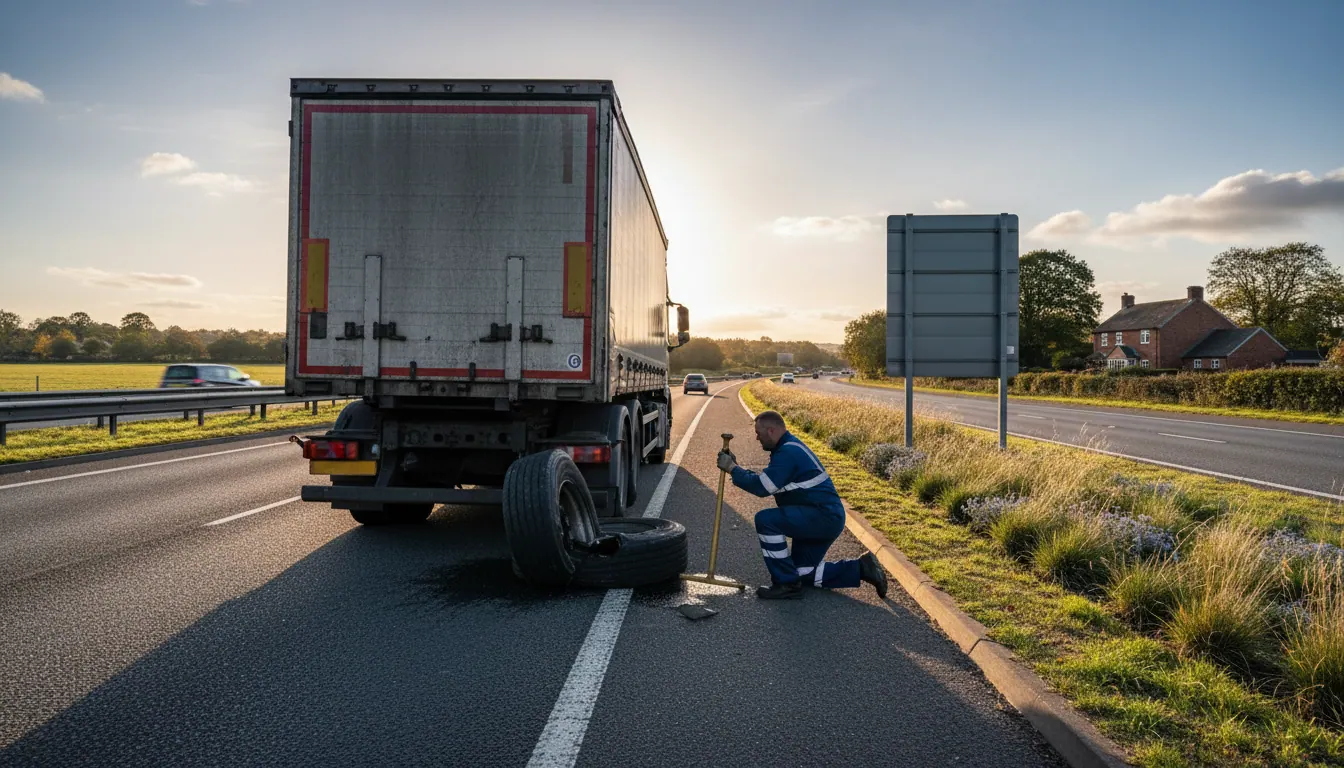
A tyre blowout on a loaded HGV is one of the fastest ways to lose a day's revenue and put your operator licence under scrutiny at the same time. The tyre itself is the immediate problem. The DVSA implications are the one that keeps transport managers awake.
When a truck shreds a drive axle tyre on the M1 southbound near Junction 28, or drops a trailer tyre on the A38 through Burton, the sequence of events that follows matters enormously. Who you call, how the repair is documented, and whether the vehicle is made genuinely roadworthy before it moves again all feed directly into your OCRS score and your ability to satisfy a Traffic Commissioner if questions are ever asked.
We attend blowouts across the East Midlands and South Yorkshire, from the A50 corridor through Stoke and Derby to the M1 junctions serving Nottingham, Sheffield and beyond. Our breakdown line runs 24 hours a day, 365 days a year on 01332 916028, and our technicians attend fully equipped to repair at the roadside wherever the situation allows.
What DVSA actually looks for after a tyre incident
DVSA enforcement officers are not just interested in whether a tyre has been replaced. They want to know whether the failure was predictable and whether the operator took reasonable steps to prevent it.
A few things they will consider:
- Was the tyre already below the legal 1mm minimum tread depth across three-quarters of the breadth?
- Was there evidence of sidewall damage, cracking or previous impact bulging that should have been caught at a PMI or driver walkaround check?
- Was the repair carried out to a safe standard, or did the vehicle continue in service with a temporary fix that compromised roadworthiness?
- Is there a maintenance record showing the tyre was inspected and the defect was either not present or not detectable?
A blowout caused by a nail or debris on the carriageway is very different from one caused by a tyre that was already compromised. The first is bad luck. The second is a maintenance failure, and DVSA will treat it accordingly.
If your PMI records are current and your driver defect reporting is properly documented, a blowout becomes much easier to defend. If your records show the tyre was flagged two weeks ago and nothing was done, you have a problem that goes well beyond the roadside call-out. Our PMI safety inspection checklist article covers what examiners look for in detail.
What our roadside tyre repair actually involves
When you call us after a blowout, the first thing we do is establish exactly where you are and what you are running. Location, vehicle type, axle configuration, whether the trailer is loaded. That information determines what the technician brings.
Our technicians attend fully equipped. For a drive axle blowout on a rigid or artic, that means arriving with the tools and equipment to remove the damaged tyre, inspect the wheel and hub for secondary damage, and fit a replacement that is correctly matched to the axle load rating.
A blowout rarely damages only the tyre. High-speed failures on motorways frequently cause:
- Wheel arch and mudguard damage on the vehicle or trailer
- Brake chamber and ABS sensor damage if the tyre debris wraps
- Damage to airlines and electrical connections on trailer landing gear
- Secondary damage to adjacent tyres if the failure is severe
We inspect all of this at the roadside before the vehicle moves. Sending a truck back onto the M1 with a new tyre on a wheel that has taken impact damage is not a fix. It is a deferred problem.
Where secondary damage is found, we repair what we can at the scene. Where a fault requires workshop attention, we tell you clearly before the vehicle moves, so you can make an informed decision about whether to recover it or run it under instruction.
The DVSA roadworthiness standard does not change at the roadside
Some operators assume that a temporary roadside repair buys them time to sort things out properly later. That is not how DVSA sees it.
The standard for a vehicle re-entering service after a breakdown repair is the same as the standard for a vehicle leaving your yard on a Monday morning. Roadworthy means roadworthy. If a DVSA officer stops the vehicle at a check site on the A50 an hour after the blowout and finds a tyre that is not properly seated, a wheel nut that has not been torqued correctly, or an ABS fault that was not present before the incident, the operator is answerable for it.
That is why we do not cut corners on roadside tyre work. The job is done to the same standard we would apply in the workshop at Calk Mill Farm, Ashby Road, Melbourne, Derby, DE73 8BJ. Wheel nuts are torqued correctly. Secondary damage is identified and addressed. The driver gets a clear account of what was done and what, if anything, needs follow-up.
What operators on the A50 and A42 tell us
The A50 between Derby and Stoke and the A42 running south from the M1 towards the M42 are both high-mileage trunk routes for East Midlands distribution and manufacturing traffic. Blowouts on these roads happen at speed, often on loaded outbound runs.
One of the things we hear consistently from transport managers who use us regularly is that the speed of return to service matters as much as the quality of the repair. A truck sitting on the hard shoulder or in a layby for three hours waiting for a recovery wagon is costing money every minute. A technician who arrives, assesses, repairs and gets the vehicle moving again in a fraction of that time is the outcome operators actually need.
The guys here are brilliant very accommodating no job to big or small, they work fast and to a very high standard as in this business a vehicle of the road is lost money and they understand this. Highly recommend 👌
That review from horizontravelgroup captures exactly the operational reality. A vehicle off the road is lost revenue. We understand that because we work in this industry. The goal is always to get the vehicle moving safely, as quickly as the job can be done properly.
Preventing the next blowout: tyre checks within your PMI cycle
Roadside repair gets you out of trouble. Planned maintenance stops you getting into it.
Tyre condition should be checked at every PMI inspection as a matter of course. That means tread depth across the full width, sidewall condition, valve condition, inflation pressure and matching across axles. A mismatched tyre on a drive axle, or a tyre running at significantly different pressure to its pair, creates uneven loading that accelerates wear and increases blowout risk.
If your PMI intervals are stretching because of operational pressure, or if your driver walkaround checks are not picking up early tyre deterioration, those are the gaps that lead to blowouts on the M1 at 3am rather than a flagged defect in the yard.
We carry out planned preventative maintenance and PMI safety inspections from our Melbourne workshop and on-site at operator yards across the East Midlands. Combining your routine tyre checks with a full PMI means nothing gets missed. Our article on planned preventative maintenance for HGV fleets explains how scheduled checks reduce emergency call-outs across the board.
Tyre blowouts and your operator licence: the bigger picture
A single blowout, dealt with properly and documented correctly, should not threaten your operator licence. A pattern of tyre-related defects, poorly maintained records and vehicles re-entering service in a questionable state is a different matter.
DVSA's earned recognition and OCRS systems mean that your maintenance history follows you. Repeat prohibitions or improvement notices relating to tyre condition will be visible to enforcement officers at roadside checks and will influence how your operation is perceived at any future public inquiry.
The operators who manage this well tend to share a few characteristics. Their PMI records are complete and current. Their drivers understand what to look for and report it. Their repair history shows defects being fixed promptly and properly. When a blowout does happen, it is an isolated event in an otherwise well-maintained fleet, not one entry in a long list of tyre-related issues.
We work with fleet operators across Derbyshire, Nottinghamshire, Leicestershire and South Yorkshire who want to run that kind of operation. Whether you need a one-off roadside repair or a maintenance contract that covers your whole fleet, we can help.
Frequently asked questions
Can an HGV legally continue after a tyre blowout if a spare is fitted at the roadside? Yes, provided the replacement tyre is roadworthy, correctly matched to the axle load rating, properly fitted and torqued, and no secondary damage to the wheel, hub or brake system is present. The vehicle must meet the full roadworthiness standard before it re-enters service. If there is any doubt, the vehicle should not move until it has been properly assessed.
Does a tyre blowout affect my OCRS score? Not automatically. A blowout caused by road debris that is repaired properly and recorded correctly is unlikely to affect your score. A blowout that results in a DVSA prohibition, or that reveals underlying maintenance failures, can contribute to a deteriorating OCRS. The quality of your documentation matters as much as the repair itself.
What secondary damage should I look for after a high-speed blowout on the M1 or A38? The most common secondary damage includes ABS sensor and brake chamber impact damage, torn or cracked mudguards, damaged airlines and trailer electrical connections, and in severe cases, structural damage to the wheel arch area. A thorough inspection before the vehicle moves is essential, not optional.
Do you cover tyre-related call-outs across South Yorkshire as well as the East Midlands? Yes. We cover the M1 corridor into South Yorkshire, including the routes around Sheffield and Rotherham, as well as the A38, A50, A42 and A52 across the East Midlands. Our breakdown line is answered 24 hours a day, every day.
Get in touch after a blowout or to plan ahead
If you are dealing with a blowout right now, or you want to talk through how your current tyre maintenance sits within your PMI cycle, call us on 01332 916028. We are on the line 24 hours a day and our technicians attend fully equipped to repair at the roadside, wherever you are across the East Midlands and South Yorkshire.